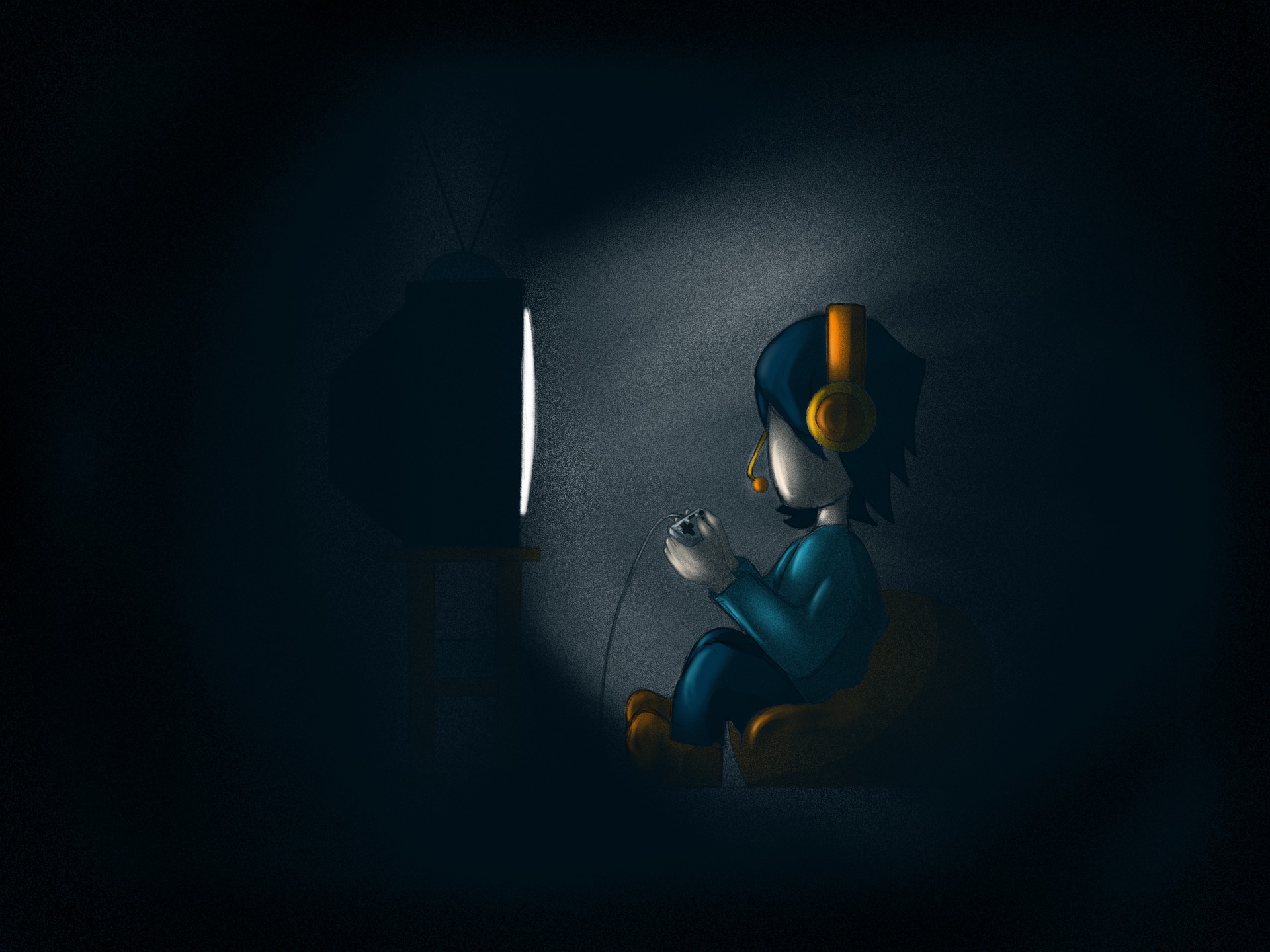








Todays game is yet another melancholy title that follows the characters life from birth to death in a very creative platforming style. And Everything Started To Fall was created by Alexitron and Heatex, as it aims to show life through a small very short window mirroring life.
And Everything Started To Fall really is a very emotive and emotional journey that you take with this character as he has to jump over hurdles in his life. As you progress further on you will start to be put up against an array of ever more difficult platforming events which you must try to overcome, but to what end.
The reward in the game is somewhat unconventional and is actually quite easy to guess just by looking at the theme of the game, as death is inevitable here.
Average play time – 5 minutes
And Everything Started To Fall is a short but sweet game that casts a light inwardly on to all who play it as it tries to highlight a lifetime of achievements and experiences into just a few minutes, which actually helps to put life into perspective.
If you are a developer with A fun indie game that can be played over a coffee break, we want to hear from you! Private message us on twitter @IndieGameMag or shoot us an email at editors@indiegamemag.com with the subject “Indie Intermission” and you could be our indie intermission pick of the day!
“As with past batches,” the announcement from Valve reads, “these titles will be released independently in the months ahead, as they complete development and integrate with any of the Steamworks features they are interested in utilizing. Some will undoubtedly launch with Steam Early Access, while others are ready to launch in full soon.”
Visit Steam Greenlight and help your favorite game get selected for the next batch.
Check back with IGM in the coming weeks, as we take a closer look at many of these titles.
The premise behind Bin-Glo, which was posted to the App Store back in June of 2011, is that you pull a spring back to shoot a ball at a bunch of numbered bubbles in order to hit the bubbles listed on your “card”. Add in a number of different modes, some dance music, a dull neon-ish UI, and there’s your game. Sounds exciting, doesn’t it? Well, the irony is that the game’s concept isn’t really that bad. It’s just the execution that is.
From the start, I knew there were going to be problems when the game prompted an Open Feint login screen. The Open Feint service was shut down in December of 2012, and prior to that, all developers using the service were asked to remove the API from their games to avoid confusing their players. After skipping the now defunct Open Feint options, I continued on my path of disenchantment as I perused the game’s menus. It’s clear not a lot of thought was put into the colorful yet very simple pseudo-neon looking user interface. The addition of dance music only adds to the banality of the experience.
Confusion settled in when I tapped the Play button and was presented with the mode select screen. There are two main game modes, Classic and Maze, and then there are about 20 “Crazy Modes” that modify the gameplay of the two primary modes. Fortunately, only the default Normal mode in the Crazy Mode list is available from the start, so I only needed to choose between Classic and Maze with the Normal mode modification. Still with me? Actually, after looking at it for a minute, I realized how it was set up, and the confusion dissipated. However, in general, it’s a good idea to ensure your players are not confused at all when first starting to play.
The only real difference between Classic and Maze is that Maze adds some walls to the playing field, making it more difficult to achieve the goal. Thus, Classic is the better mode with which to start. Unfortunately, because of poor controls and a major bug with said controls, neither mode is desirable. You’re provided with a spring on the left side which, when pulled back and released, shoots a ball at a handful of numbered and colored bubbles (yes, the game labels them as bubbles, though they look more like glowing buttons). The first and most noticeable problem is that the farther you pull back on the spring, the closer your thumb gets to the pivot point of the spring, and the more difficult it is to aim precisely. As you may know, the closer an actor is to the pivot point of a rotating object, the less movement is required to rotate that object. However, the sensitivity of the spring does not adjust, so small thumb movements close to the pivot point result in sudden wide angle changes. To add frustration on top of frustration, if you pull back so that your thumb is just at the edge of the screen, you will often encounter a game-killing bug that causes the spring, ball, and all bubbles to disappear. You then must restart the level. The upside of all of this is that you don’t have to pull back that far to shoot adequately. But that doesn’t mean people won’t. In fact, it’s easier to see the ball’s projected path if you do. Simply put, leaving such a serious bug in the game is a big no-no.
Even if you can manage the control issues, the gameplay is still lackluster. Out of the handful of bubbles in the field, one or two of them are ones on your list at the top of the screen and thus ones you want to hit. Each time you hit one, it disappears, and a new bubble appears. A timer tries to keep you from being too methodical, but many times I completed a level without even paying attention to where I was shooting. Later stages add fire bubbles that reduce the time left, and every fifth level is an entirely different game in which you compete against an AI “shadow” opponent in seeing who can pop specific bubbles the fastest. A series of numbered bubbles scroll along the top, and the one that’s highlighted is the one you need to find and pop amongst about 10 other bubbles on the field. This mode broke the bank for me. The AI was always faster in general than I, scoring twice as many bubbles. After trying a few times, I finally gave up and moved on to try the other modes.
Maze mode (a misnomer as the walls do not really create a maze – they’re just barriers laid out perpendicularly to the path of the ball) was mentioned above, and the rest of the modes simply add or change one element of the game, such as increasing or decreasing the bounce of the ball or causing the ball and bubbles to move erratically. One other feature is barely worth mentioning, as it’s used only once in a while: shaking the device will cause bubbles to move slightly, allowing you to more easily hit one bubble sitting behind another. Finally, if you get tired of hearing the dance music (which is easy since it’s one song repeated over and over), your only option is to disable all sound, thus turning off the sound effects as well. And of course, playing your personal music library is not an option. All just icing on the cake.
Whether you’re a fan of bingo or pool or even of games in general, I recommend staying away from this one. But if for some reason you feel the need for some masochistic gameplay, at least Bin-Glo is at the popular price of free.
Review summary
Pros:
Numerous game modes
Colorful graphics
Easy to pickup gameplay
Free
Cons:
Major control bug
Controls are not user friendly
Lackluster gameplay
Very difficult player vs. AI level
Repetitive music
When video games first came around we saw games that allowed you to battle the beasts of hell, race F1 cars, and explore far flung worlds. Basically if you could imagine it A game would come to cover you.
With all these wild fantastic ideas you would never expect developers to create games about working in retail (Cart Life) or other mundane ventures, however Lucas Pope has created the latest simulator to simulate the life of a border control agent during the 1980s.
Papers, Please is a dark insight into the life of a border control agent for an imaginary eastern block country during the cold war era. Papers, Please is equal parts mundane as it is brilliant as you set out to complete ever more complex and comprehensive checks on people moving over the border working to the time constraints set in place by the working day.
Papers, Please is such a dark and depressing insight that it gives this game such gravity it is impossible to resist the call of this mundane lifestyle.
Average play time – About an hour
Papers, Please is currently still in beta although if the current beta is anything to go by I am sure the finished game will be a dark and moving insight into humanities struggle to provide for their family.
Be sure to check out Papers, Please and find out just why the mundane is so magnificent. Papers, Please can be downloaded via Lucas Pope’s Site.
If you are a developer with A fun indie game that can be played over a coffee break, we want to hear from you! Private message us on twitter @IndieGameMag or shoot us an email at editors@indiegamemag.com with the subject “Indie Intermission” and you could be our indie intermission pick of the day!
Discord Games is currently seeking funding on Kickstarter for Chasm, a 2D action-RPG featuring procedurally generated Metroid-like dungeons and stylish pixel art. A demo is available for Windows/Mac/Linux on the Kickstarter campaign page, and Discord Games plans to release the game in early 2014, if the campaign is successful. Chasm is inspired by the 2D platformers of the past, and will utilize gamepad support to compliment the game’s retro art-style.
“…this game can not be made without your support,” Discord Games says on the campaign page. ” We’ve been waiting forever for a game like this, but game publishers today just aren’t interested in projects like this one. With your support, we will be able to finish the game ourselves and give you a truly amazing experience.”
Last year, indie developer Hitbox Team released their first game, Dustforce, on Steam. A little over a year later, Hitbox Team is happily reporting on their financial success and providing valuable feedback to other developers within the indie game scene.
In a blog post, on the official Hitbox Team website, developer Terence Lee went into detail about the specifics of the team’s financial strategy going into developing their first game as a team, and the inspiring outcome of their risky endeavor.
“Now that we’ve finished our own first project, we’d like to contribute our own data about Dustforce to the growing trend of transparency in indie game development,” Lee explains. He goes onto explain that the origins of Dustforce began in the rush to complete the original prototype in the months leading up to the 2010 IndiePub Games Independent Game Developers Competition. In the end, the prototype won the team a $100,000 check, and armed with financial stability, the team was able to completely focus on developing their prototype into the game as it exists today.
Though, Lee pointed out, just like motivation and patience, money will eventually run out, and so the team set a strict deadline: have Dustforce completed by January 2012. An invitation by Valve to release Dustforce on Steam and some positive press following the prototype’s award provided the extra boost to get the project rolling.
Lee goes on to discuss how the four-man team figured out living expenses, and established monetary goals that Dustforce would have to meet, in order to be considered a financial success.
“We had no idea what to expect. We could only speculate, using sparse data points and ballpark figures. Was the past year and a half worth it? Of course it was, —we worked the hardest any of us have ever worked, and we created something we were truly proud of. Yet, there was a lingering uncertainty of financial expectations. Our goal was to just make enough money to be able to do it again. If we could work on our next project independently and without being restricted by a financial cut-off date, then we’d consider Dustforce a financial success.”
Nine days following Dustforce’s January 17th, 2012 release date, the game was a financial success. After the initial surge of post-launch sales, Dustforce was selling 30-50 copies daily. Then, in the first week of May, Hitbox Team got their first taste of a Steam Sale.
“Over the 3 days of the promotion, we sold 17,462 copies of the game, more than the amount we sold during the first 3 days of the January launch. Of course, at 50% off, the revenue was a bit less, but it was still an instant 37% boost in lifetime revenue.”
Hitbox Team’s Steam Sale Figure
When the Humble Bundle 6 launched in September of last year, Dustforce was one of the games included. The Humble Bundle promotion not only brought Hitbox Team roughly $153,915, but they also saw an uptick in Steam sales, following the conclusion of the promotion.
“Dustforce was our first finished game, and we went into it without much experience, especially in the business side of things. Through this project, we learned firsthand that time is money, and that sacrifices have to be made when resources are limited…We are really grateful to have a strong start, and are very happy with how the game turned out…We are all humbled and elated by how well Dustforce has been received. The joy from our players is enough to keep us making games, —the financial success is just an incidental blessing.”
In January, following the one-year anniversary of Dustforce’s release, Hitbox Teamannounced their next title, Spire.
Welcome to IGM Under Construction, where we cover indie games that are not finished quite yet. Be they Alphas, Betas, or Preview Builds, we will be covering them once a week.
In Guns and Robots, the robots come in three module classes based on the player’s assembly and unlimited options for character customization.
If you’d like to see your game featured in an upcoming Under Construction video, send us an email at editors[at]indiegamemag[dot]com .
Be sure to Like the video and Subscribe to our channel to be notified of our latest content. Please let us know what you think of the game. Leave your comments below!
Since I have been doing this daily column there is one genre that I have actually managed to avoid for the most part, even though it makes up a rather big percentage of online indie games. I am of course talking about the much loved tower defence genre and even though there is so much competition in this market I think I’ve found a very special one here.
Demonrift TD is a game that has been developed by Menara and offers a bit more than just a rather average tower defence game, by including a strong narrative and some interesting overarching resource management Demonrift TD is a very well designed tower defence game.
A key point in Demonrift TD is as you progress through the game world and take over towns you are able to collect resources from these places each turn. You must then spend these resources on various upgrades that will determine just how well you do on the following levels.
Average play time – Less than an hour
Demonrift TD features a great deal of content that fits together very well, it is easy to see just how much time has been put into the game. Demonrift TD offers much more than just a mediocre tower defence by giving you strategic resources to manage, spending them on upgrades that really adds another level to this game.
To play Demonrift TD head to Kongregate and see just why this tower defence shines above the rest.
If you are a developer with A fun indie game that can be played over a coffee break, we want to hear from you! Private message us on twitter @IndieGameMag or shoot us an email at editors@indiegamemag.com with the subject “Indie Intermission” and you could be our indie intermission pick of the day!
Welcome to the weekly roundup of free indie games, this week I’ve found quite a few awesome retro inspired titles to have fun with. The games this week have ranged from zombie shooters to side scrolling shooters and pretty much everything in between.
As always clicking the title will take you to the original article whilst clicking the image will take you to the game.
Atomic is an interesting arcade game that has taken a great deal of influence from Super Hexagon along with bullet hell games. Atomic combines the two very different styles of games together to create this fast paced arcade title that is a great little time waster.
Zombie Grinder is a great little multiplayer zombie shoot em up in which you must battle through the unrelenting hordes of the undead to try and reach new high scores and unlock new items. Although still in the beta stages Zombie Grinder already offers a great deal with a great selection of maps and modes to keep you busy for several hours.
This one is for all of you who played the classic side scrollers back in the 80-90s as Maldita Castilla aims to bring back what made this decade of gaming great. Along with awesome visuals expect compelling gameplay that really does throw back to the golden age of gaming.
Who would’ve thought that a helicopter could get taken down by a swarm of giant bats? Although this may sound implausible it does end in some rather interesting results. Bat Country is all about the old style arcade flight games with strange stories and a distinct pixel art style that although rather simplistic is also elegant.
Endless Forms Most Beautiful is a PC port of the original Spectrum game and thus feeds into the retro vibe of the week. Each level consists of just one screen in which you must pick up all of the mushrooms before the enemy get you. Although the idea is simple actually obtaining all of the mushrooms can be very challenging especially on the later levels when ranged enemies get introduced.
——
This brings us to the end of another week in indie gaming. I hope you have all enjoyed the games that I have selected this week. Please come back tomorrow for an all new game and the start of a new week of Indie Intermission.
If you are a developer with A fun indie game that can be played over a coffee break, we want to hear from you! Private message us on twitter @IndieGameMag or shoot us an email at editors@indiegamemag.com with the subject “Indie Intermission” and you could be our indie intermission pick of the day!
IGM had a chance to chat with Laurent Lavigne of Elefantopia on his hectic tower defense game, McDroid. McDroid is a gorgeous cel-shaded tower defense and 3rd person action adventure game where you collect strawberries. The game is currently still in Beta and available for PC, Mac and Linux.
When did you start developing games? What got you into programming and designing?
I started when I was 10, made a few rooms in a first person adventure game on my TI 97, then at 15, I completed the graphics for a game that was inspired by RTYPE, horizontal shooter with wave gun and modular weapon system in the back that doubled as a shield. Sold it to Thalamus, the company went under before the game became anything more than one level on the Amiga but it was a really fun level.
What game inspired you to make games? RTYPE but MULE and Gauntlet are close second, what am I saying, Marble Madness and Buck Rogers, The Pawn, Tass Time… they all build such a rich canvas of feelings.
What is your favorite indie game right now that you are playing? Why?
I am not playing any indie game at the moment, the free time I have I dedicate to McDROID and the real world. But I did spend hours on FTL and loved it, it was scratching that grinding itch and showed me some really tight gameplay and subtle bindings I’ll re-use.